

Miscarriage Series - Part 5
Part 5 of my miscarriage series - three meditations to help with the release of the pregnancy, grief, and a message of hope.
This part five of a five part series, based entirely on miscarriage. It will talk about signs and symptoms of miscarriage, physical health, medical care, holistic care, physical healing, emotional healing, memorials, how to help a friend of family member, and will have three meditations available to listen to.
In my shop there is a document with every handout in one file, if you want to download them that way instead of individually from each post. There is a small fee for this to help with costs. The posts and handouts on each post are available for free, though donations are appreciated for the work to create this resource and also to help those going through a miscarriage. Links to donate are available at the end of each post.
——————
Meditation #1: To help with the physical release
Meditation #2: Feeling all you need to feel
Meditation #3: A Message on Hope
——————————————
If you wish to donate to my business to help those going through miscarriage, you can below as well. I offer holistic loss services as donation based fee only.

Miscarriage Series - Part 4
Part 4 of the miscarriage series - How to help friends and family after a miscarriage.
One of the hardest parts many find is how to be there for someone they love while they are going through a miscarriage without being a burden or saying the wrong thing. I wish I could say that you will never say the wrong thing or that you will be the perfect support. Life isn’t that easy. But there are many things you can do to make sure you are helping them through the pain instead of adding to it. Don’t be afraid to be with them, your disappearance can be just another thing they’ve lost. If you learn anything from this let it be this one thing - don’t leave them.
This part four of a five part series, based entirely on miscarriage. It will talk about signs and symptoms of miscarriage, physical health, medical care, holistic care, physical healing, emotional healing, memorials, how to help a friend of family member, and will have three meditations available to listen to.
In my shop there is a document with every handout in one file, if you want to download them that way instead of individually from each post. There is a small fee for this to help with costs. The posts and handouts on each post are available for free, though donations are appreciated for the work to create this resource and also to help those going through a miscarriage. Links to donate are available at the end of each post.
——————
One of the hardest parts many find is how to be there for someone they love while they are going through a miscarriage without being a burden or saying the wrong thing. I wish I could say that you will never say the wrong thing or that you will be the perfect support. Life isn’t that easy. But there are many things you can do to make sure you are helping them through the pain instead of adding to it. Don’t be afraid to be with them, your disappearance can be just another thing they’ve lost. If you learn anything from this let it be this one thing - don’t leave them.
It can be daunting to face death, especially of a baby. Babies aren’t supposed to die. Babies are supposed to live, bring us joy and laughter. Death doesn’t do that. And so often, the way we get through death is remembering times when they did bring us joy, yet in miscarriage that isn’t really a possibility. There aren’t birthdays to remember, milestones, memories of smiles. There is just a hole.
There is a really great idea that grief and holding space are about circles. It’s called The Ring Theory, and it beautifully applies to miscarriage.
I’m going to quote from the author of this theory:
The person in the center ring can say anything she wants to anyone, anywhere. She can kvetch and complain and whine and moan and curse the heavens and say, "Life is unfair," and, "Why me?" That's the one payoff for being in the center ring. Everyone else can say those things too, but only to people in larger rings.
When you are talking to a person in a ring smaller than yours, someone closer to the center of the crisis, the goal is to help. Listening is often more helpful than talking. But if you're going to open your mouth, first ask yourself if what you are about to say is likely to provide comfort and support. If it isn't, don't say it. Don't, for example, give advice. People who are suffering from trauma don't need advice. They need comfort and support. So say, "I'm sorry," or, "This must really be hard for you," or, "Can I bring you a pot roast?" Don't say, "You should hear what happened to me," or, "Here's what I would do if I were you." And don't say, "This is really bringing me down."
If you want to scream or cry or complain, if you want to tell someone how shocked you are or how icky you feel, or whine about how it reminds you of all the terrible things that have happened to you lately, that's fine. It's a perfectly normal response. Just do it to someone in a bigger ring.
"Comfort in, dump out.”
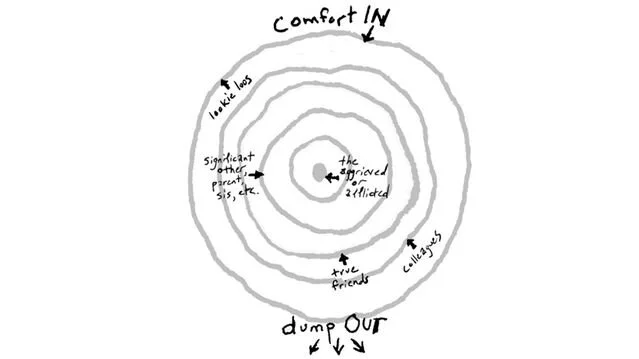
Illustration by Wes Bausmith
The person most affected by this is the pregnant parent. The next is their partner. You are not in the center ring in this situation - EVER. You are in a larger circle than them. You need to dump all of that out to a larger circle. It isn’t about you.
This one thing is so important to remember. Be there, and comfort in, dump out.
Now, don’t let this intimidate you. It’s scary. And even as someone that has been through repeat loss, I say the wrong thing sometimes. All we can do is try not to do it again, and be aware of what we are doing. It’s that simple.
As for don’ts - this is HUGE. And a big part of this I’ve already written about. DO NOT LEAVE THEM. Be there. Check in. Don’t expect answers back, but make sure they know you are there. They aren’t ignoring you, because it isn’t about you. They are dealing with this the best they can, and they deserve your love and trust.
Platitudes are gross. Try really really really hard to never use one. They feel impersonal, and to some can even feel like an attack.
These include:
“Try to think positively” - positivity can suck it. Grief isn’t a bad thing and positivity isn’t the answer.
“At least…..” - THIS ONE SUCKS. There is no at least about miscarriage. It’s whole and encompassing, and at least diminishes it.
“I know how you feel” - remember: COMFORT IN, DUMP OUT
“Everything will be okay” - you don’t know that.
Never ever ever ask if they are over it. Even if it’s 50 years from now. No one would ask someone if they were over their partner dying, so don’t ask it now. The loss mattered, their grief matters.
Don’t disappear. In 2-4 months, things will get much worse for them, and they will need everyone they can.
Don’t dump your crap on them, unless they ask and seem truly interested
Again, don’t be intimidated. Keep showing up, even if you stick your foot in your mouth. In the end, when the fog lifts and their grief is a little smaller, they will remember that you were there. That’s so important.
I figured I would end the post with practical tips on how you can help, and know that even if you can’t do any of these because of distance or personal stuff or any other reason, that’s okay too.
I know I’ve repeated this numerous times in this post, but let them know you are there. If you are available in person, let them know specific times you will be by. Things such as this:
“I’m bringing dinner by at 5:45. You don’t need to answer the door, I will leave it outside if you don’t answer. I will text/call when I get there to let you know.”
“I’m coming by on my lunch break at 1pm, I would like to do some laundry or clean for you. If you’re okay with that, leave the door unlocked or answer when I knock. If you aren’t, that’s ok. I’m available if ever you are.”
If you call or text and they don’t answer, this is not a reflection on you. They are going through something and sometimes it’s just too hard to even wake up, let alone talk to people. Know that it isn’t about you, and they appreciate the reaching out.
Sit with them, in silence if they don’t want to talk. You can’t fix this with words, but your presence can be a comfort.
ALWAYS USE THEIR BABY’S NAME IF YOU KNOW IT. This is the biggest thing you can do with your words. USE THE NAME ALWAYS. You aren’t reminding them, you aren’t making them sad, you are agreeing and showing you loved that baby as well. You are giving them a gift by acknowledging the life that existed.
It’s okay to cry if you are with them. Seeing someone else have big emotions can help them express their own.
Do something whenever you visit
Pick up trash, take the trash out, do the dishes, do laundry, vacuum, cook for them. Anything!
They may not notice things that need to be done, but even if they do, these little acts of physical love are important so they know they aren’t forgotten, and it will lighten their load just a little.
They may not even notice you did it, AND THAT IS OKAY. It’s not for them to say thank you and show gratitude right now. It’s for you to put comfort in. That’s it.
If you pick up mail or anything else, whether from a mail box or inside the house, make sure to put it in a central location that they know about. Bills can be forgotten in this time, and no one wants their power shut off because they don’t remember getting a bill.
Remember the important days
The day they died, the day they were born, their due date, first birthday. Those days matter in the years to come. One of my most treasured things is someone remembering their birthday. It doesn’t happen often, yet every time it does it is one of the most amazing feelings.
If the funeral (if there is one) is published in the paper, have someone stay at their house. Burglaries are common during this time, and having someone at the house can ease the parents’ mind so they can grieve and say whatever they need to without worry.
Small things in this time matter. One day they will wake up and things will be a little clearer, and when that happens, you don’t want to miss it because you walked away. When they laugh for the first time, when they want to go out to dinner or a movie, when they want to do something - you want to be there for those. There is no guarantee that every day will be good once that starts, because grief is like an ocean wave - coming and crashing against you when you least expect it. Be there for the good and the bad - it matters.
A very dear friend Kristine Brite McCormick wrote a wonderful booklet titled “When Your Friend’s Baby Dies”. Her daughter Cora died at 5 days old, and after many missteps and people asking what they could do since they had never been in this before, she wrote this to help. It’s 24 pages long, and worth the purchase and read.
You get a text message or voice mail you'll never forget. Your friend's child has died. You want to help, but you're afraid of doing something wrong or overstepping your bounds. Kristine Brite McCormick, who lost her baby at five days old to a heart defect, guides you through some suggestions for helping your friend and gives you the insight from her experience as a babyloss mother in this booklet. This short and easy read offers practical tips about how to help after your friend's baby dies and also gives you an insight into what your friend might be feeling.
In the end, remember the one thing - just be there. It truly matters.
—————
Below is the one handouts as an image file that is free to download. Simply click the image to be taken to the file. If you wish to have higher quality PDFs, please visit my store for the file containing every handout in this series.
If you need a coupon code or the files for less than the $10 they sell for, please reach out to me.
If you wish to donate to my business to help those going through miscarriage, you can below as well. I offer holistic loss services as donation based fee only.


Miscarriage Series - Part 3
Part 3 of my miscarriage series - this one about emotional healing, grief, and creating something to remember your baby.
This part three of a five part series, based entirely on miscarriage. It will talk about signs and symptoms of miscarriage, physical health, medical care, holistic care, physical healing, emotional healing, memorials, how to help a friend of family member, and will have three meditations available to listen to.
In my shop there is a document with every handout in one file, if you want to download them that way instead of individually from each post. There is a small fee for this to help with costs. The posts and handouts on each post are available for free, though donations are appreciated for the work to create this resource and also to help those going through a miscarriage. Links to donate are available at the end of each post.
——————
In part one I wrote what a miscarriage is and how it can happen, and in part two I wrote about medical care, holistic care, and how to help your body physically through a miscarriage. Those are things not talked about enough, as miscarriage is seen as shameful (only to ourselves, rarely ever do outside people think that).
So now that the physical is out of the way, let’s dive into the emotional. No one likes discussing grief and emotions, yet so much of miscarriage is tied to this, especially after it happens.
I’m sure most are aware of the Five Stages of Grief. It’s not something that I really think applies! Sure, there are five stages, but in grief, you don’t calmly go from one to another; you jump around. One day you may wake up and be completely okay with what happened, and then the next be a ball of anger that nothing can calm. It’s a process, and most times it lasts forever. Grief is the price of love.

This is one of my favorite graphics on grief, mostly because it perfectly explains what I went through. Yes, some may not grieve this way, but it’s still important to know if that isn’t you, because others might. Grief isn’t a straight system, it’s complex and messy and confusing.
None of this to say there isn’t help out there or ways to make the process easier! You do need to feel the emotions and grief, to find a place to put the love you had for the baby you couldn’t keep, even if you didn’t plan to keep it, because your body remembers everything.
It may seem out there, thinking of your body having memories, your body grieving even if the outcome was something you wished for, but there is a lot of evidence out there that muscle has memory, your body feels things that you may not realize were an issue, and we hold onto hard things without meaning to. Phantom limb pain, driving a car without thinking about how you’re doing it, being awake yet seeming to do things without being aware. All of those are signs your body knows what is happening even when your conscious mind doesn’t.
There are many options to help your grief and your emotions, though I will only go through a few:
Support groups, Community Care, and Online Resources
These can be in person, online in groups or message boards, over the phone, on zoom (since this is the way everyone is communicating currently!). You don’t have to do things in person to get the support you need during and after a loss.
There are a lot of amazing online resources, many of which I used myself when going through repeat miscarriages. Things have changed over the last decade, but they are still available and can be a wonderful way to get a friendly shoulder if you don’t want to tell those in your family what is going on.
Stillbirthday - Heidi has created a wonderful resource for all phases of loss, with birth plans, support groups, information, and more resources to help you find whatever you need to get through.
She also does a heart release every year, writing names of thousands of babies by hand, for free. Heart Release
Still Standing Magazine - A ton of resources on all stages of loss, including LGBTQA+, and an online free support group
Grieve Out Loud - The facebook page is also a great resource, with a free online support group. Their penpal program is one of the coolest parts of what they do. Years ago in the midst of everything, I was one of the penpals. I had five or six people I wrote to to check on, and also had a penpal for myself to write to when things were really bad. The way that loss parents love each other is such a wonderful part of a heartbreaking community.
They also have a massive resource page
If you are a health care worker, PLIDA is for you. The Pregnancy Loss and Infant Death Alliance is a formal network to increase awareness and training for loss support.
Share is a national organization for pregnancy and infant loss. They have chapters set up all over the country, and provide information and resources for families, providers, and those going through a loss. Most chapters have their own support groups.
Therapy!
This is not a bad word!! It is not wrong to need extra help from a professional. Money may be an issue for this, and many offer cash prices if you do not have insurance, and it can make a huge difference in your healing.
There are many kinds of therapists, and some even work solely online. It’s okay to take your time finding a good fit, and even if it’s just sporadic care, it can make a big difference.
Try to find one that is trained in grief, loss, trauma, if possible. If not, find one you fit with.
Self-Care
This does not need to be expensive spa days! It can be something as simple as eating a meal every day.
One of the pictures or PDFs is a self-care checklist, very simple things to make sure you are taking care of yourself in a hard time. It can be hard to remember to eat or drink, and showering may be too hard and require too much effort. All you can do is try, and that’s enough.
For many, there is nothing to remember their baby or pregnancy - not even stretch marks. You didn’t buy clothes, you didn’t make anything, you didn’t have anything to keep from the physical loss, and many may not even know you were pregnant and had a miscarriage. It can be hard to feel emotions when there is nothing tangible to grieve. This is where memorials come in.
Some cemeteries will allow the formal burial of any human remains, regardless of gestational age. They are more rare, and many states won’t allow burial before 20 weeks, or after the age of miscarriage. It sucks, and in turn makes cemeteries hard places for those without that physical place to go to grieve their loss. If this is something you want, many cemeteries will work with you, even letting you use other plots you own, like grandparents, and bury remains in the same place. Some even allow you to dig your own hole and have your own plot for a very small fee. The worst that can happen is they say no, so if you are wanting this, reach out.
Having a ceremony can be a healing experience
This can be something as simple as having friends and family meet at a neutral location like a park, and release flowers or seeds or balloons.
However, if you are considering a balloon release, please know that it affects the wildlife in your area, and can kill them. Balloons are a wonderful way to celebrate life, but a release comes at a cost.
I’ve been to a few where we have a sort of wake and eat food and just enjoy each other. I’ve also been to others where it is a more formal ceremony, with note writing, memories given, feelings shared, and lots of tears. It’s 100% up to you to have or not.
Food is one of the best ways to remember. Mostly because it opens us up, gives us something to do instead of just talk and feel. You can find a special dish or something you craved during pregnancy, and every time you eat that or have that or even just see that, you remember your baby.
In line with that, picking something special to remember your baby can be such a healing thing.
Memorial necklaces, keychains, paintings, and more are all options. Etsy has hundreds of people that make them, and they feel personal and filled with love.
Pick an animal or object or shape that relates to your baby or you feel embodies your baby. My earlier losses I feel connected to them when I blow wishes, or the dandelion seeds. Two others are a when I see a blue dragonfly or a butterfly. A dear friend sees swirls around and knows that’s her baby saying hi. I read a thing years ago that said that every time you see a coin on the road it’s your baby saying hello. It can be anything. And you don’t have to tell anyone, it can be secret to you.
—————
Below are the three handouts as image files that are free to download. Simply click the image to be taken to the file. If you wish to have higher quality PDFs, please visit my store for the file containing every handout in this series.
If you need a coupon code or the files for less than the $10 they sell for, please reach out to me.
If you wish to donate to my business to help those going through miscarriage, you can below as well.



Miscarriage Series - Part 2
Part 2 of my miscarriage series, with information on medical and holistic care, along with how to care for your body physically.
This part two of a five part series, based entirely on miscarriage. It will talk about signs and symptoms of miscarriage, physical health, medical care, holistic care, physical healing, emotional healing, memorials, how to help a friend of family member, and will have three meditations available to listen to.
In my shop there is a document with every handout in one high quality pdf file, if you want to download them that way instead of individually as jpgs from each post. There is a small fee for this to help with costs. The posts and handouts on each post are available for free, though donations are appreciated for the work to create this resource and also to help those going through a miscarriage. Links to donate are available at the end of each post.
—————————
In the last post I talked about the physical side of normal miscarriage, along with definitions and signs of complications. It is a very basic overview of miscarriage, and in this post we will dive into the different types of care you can receive during your miscarriage, along with how to help your physical body during and after a miscarriage.
In the US, medical care given by doctors is the standard or normal for many people. Some prefer more natural means, but the majority will seek medical care before, during, and after a miscarriage, if only because that is what they are used to. Most obstetricians have to take extra classes to handle miscarriage care, and a lot of them never do this. It isn’t required to become an OBGYN. Their training is more focused on pregnancy and term delivery and all that can go wrong during that time. It’s mostly about control of what you can control.
You may not have time to think through your options before your miscarriage begins, or you may have some extra time in the case of a missed miscarriage. It is so unique to each person.
If you are interested in medical care for your miscarriage, there are a few options that you need to be aware of, since no miscarriage is handled the same as another. You are ultimately in control of the situation, even in emergencies.
The very first thing many providers will do if miscarriage is suspected in early pregnancy is order a blood draw to check your HCG levels, to be repeated in 48 hours. HCG is the hormone created when implantation occurs, and it doubles in value every 48 or so hours in normal healthy pregnancy. It never drops if everything is okay, it only goes up. The second value is the most important one because of this. One lab draw by itself can only show if you are pregnant or not, it does not say what is going on with the pregnancy. These values also become more stagnant in their rise the farther along in pregnancy, so if you are farther than 6-7 weeks, they will only show a rise or fall, nothing else related to how the pregnancy is progressing.
If you are farther than 6 weeks, many will then schedule or perform an ultrasound to check on the embryo and the uterus. Sometimes this is done before the labs are drawn, sometimes it has to wait until after. It is truly up to you and your provider. If you are less than 6 weeks, it is very unlikely to see any sort of embryo in the ultrasound, and definitely not cardiac activity. If you are earlier than 5 weeks, you may not see anything in the uterus. Knowing your dates is one important piece to getting an ultrasound at the right time, and it might be best to wait if you can to get that ultrasound.
If both or either of these are done, most providers will then wait and see before next steps, even in the case of missed miscarriage. In the case of earlier miscarriage before 10 or so weeks, they will give you the option of waiting a week or two before coming back in for more tests and then medication or surgery to end the pregnancy. Sometimes they will give you the option that day to do either of those things, but it’s not as common.
From here, you have three options.
Wait and see. Your body will probably start labor on its own and pass the contents of your uterus within a month. It can take time, and when you found out your pregnancy isn’t viable, it can be really hard to wait for the end date. For many, they need that release to start healing, and until that occurs, they live in limbo.
Medication options
The first option is mifepristone. This is a progesterone blocker, normally used in abortion, but also used if the fetus is no longer growing properly or miscarriage is imminent but the body hasn’t realized it.
The second option is misoprostol, or cytotec. This is a contraction inducer, starting the physical release of the pregnancy. This is taken at home either orally, rectally, or vaginally.
With either of these options, the embryo or fetus should pass vaginally, and you can keep the remains to do with what you will.
Surgical options
A D&C or D&E (depending on length of pregnancy and what needs to be done to clear out the uterus) is performed under sedation or general anesthesia. General is not common, sedation is the more used anesthetic.
Your cervix is dilated, and a curettage or vacuum is inserted into the uterus to clean out the contents.
In this option, you cannot keep the remains, as they have been pulled apart by the tools.
Regardless of what you choose, there are positives and negatives to each. Medication options could mean that the uterus releases its contents but leaves some behind, meaning you will need surgery anyway. Surgery comes with its own risks, and it is also possible that the uterus isn’t completely cleaned out, and you will need another one. Regardless, you will have vaginal bleeding for days or weeks after, as your body sheds your uterine lining and goes back to its pre-pregnancy state.
Now, there are those that don’t want a medical option for their miscarriage, for whatever reason. It’s 100% your call which way to go. If you don’t wish to have medical intervention, there are many options to go through.
Nourishing your body physically and emotionally during the wait. This includes getting enough food and water, along with proper rest. Your body can’t work if it isn’t being taken care of, and having a miscarriage is a lot of work. One of the best ways to nourish your body is through herbs, especially in teas and tinctures.
There are many to choose from: Red Raspberry Leaf, Ginger, Peppermint, Motherwort, Nettle, Red Clover, Echinacea, and Elderberry
It’s okay to take as long as you need. As long as you don’t have heavy bleeding and hemorrhage or signs of infection, time is on your side. Sometimes it can take a month or more for the body to catch up if left on its own, and that is not an abnormal amount of time.
In the Holistic Care Handout I have added three sections on the left side that deal with herbal ways to proceed with a pregnancy release. If you are thinking of going this direction, all you need to do is pick one thing from each section, using them from the top to bottom a few days or a week before moving on to the next section. Most of the items can be found without issue locally, regardless of where you live. They can also be used if you are in the physical process of the miscarriage and want to speed it up or aid the process.
Sometimes in this place, your body needs only one thing from you - acceptance. Not to put off grief or anything else, but to understand and feel that the miscarriage needs to happen, and that you are physically holding on through your emotions. In part six there will be a meditation for releasing the emotions and the pregnancy. Intention can be a very big part of this process. Your thoughts and feelings matter.
Now that you have figured out which way you want to go, or simply know your options on how to proceed, one of the most important things to consider during and after miscarriage is supporting your physical body. Your body has gone through pregnancy and birth, even if it isn’t what you hoped. Even being pregnant for a short time, your body went through hormonal, mineral, vitamin, and other physical shifts. During the actual release, you lost blood and other nutrients that your body needs to heal optimally and remain healthy.
One of the biggest things to do is get adequate rest. If you are constantly going, it’s hard for your body to relax, and you need to sleep to heal. Your body went through a process and needs the rest, even if it is just sitting down for an hour or two. Many workplaces won’t give sick or vacation time after a miscarriage, so take whatever you can get and relax your body.
You also need to eat well. You need to rebuild your iron levels, your blood stores, and your nutrient and vitamin stores. This is important even if you aren’t considering pregnancy again in the near future. What you do during this postpartum time matters for the next years. In Ayurveda, they say that what you do for the next 40 days affects the next 40 years.
Lastly, you need to stay hydrated! Not with soda, with water. You have to drink water. It can help prevent and alleviate headaches and migraines, exhaustion, depression, and anxiety.
—————
Below are the four handouts as image files that are free to download. Simply click the image to be taken to the file. If you wish to have higher quality PDFs, please visit my store for the file containing every handout in this series.
If you need a coupon code or the files for less than the $10 they sell for, please reach out to me.
If you wish to donate to my business to help those going through miscarriage, you can below as well. I offer holistic loss services as donation based fee only.



Miscarriage Series - Part 1
Part 1 of a series specific to Miscarriage.
Miscarriage is defined as any pregnancy release before 20 weeks gestation. This could be something as early as 3 weeks all the way to 20 weeks of pregnancy. Because so many things happen during this time in pregnancy, it can seem really odd that they are defined by the same word, but welcome to science. It is also a word that many people hate, as if you missplaced your pregnancy, as if it was under your control.
This part one of a five part series, based entirely on miscarriage. It will talk about signs and symptoms of miscarriage, physical health, medical care, holistic care, physical healing, emotional healing, memorials, how to help a friend of family member, and will have three meditations available to listen to.
In my shop there is a document with every handout in one file, if you want to download them that way instead of individually from each post. There is a small fee for this to help with costs. The posts and handouts on each post are available for free, though donations are appreciated for the work to create this resource and also to help those going through a miscarriage. Links to donate are available at the end of each post.
———————————————————
Miscarriage is defined as any pregnancy release before 20 weeks gestation. This could be something as early as 3 weeks all the way to 20 weeks of pregnancy. Because so many things happen during this time in pregnancy, it can seem really odd that they are defined by the same word, but welcome to science. It is also a word that many people hate, as if you missplaced your pregnancy, as if it was under your control.
For many people, this is a loss of a wanted pregnancy. For some it isn’t, and for others it is the wanted end of a pregnancy. There are many emotions beneath the surface, and one person’s experience isn’t the same as another’s, even if they happen at the exact same gestation and in the same way.
There are many types of miscarriage, depending on how far along the pregnancy, lab values if labs are taken, ultrasound results, and how the pregnancy is growing or not growing. Some basics to miscarriage types are:
Missed Miscarriage - when an embryo or fetus stops growing, but there are no outward signs of issues. Most of these are found either through routine ultrasound or when the miscarriage begins without other signs and symptoms of something amiss. Most missed miscarriages are treated with medical care, as waiting for the body to catch up and begin the process can be hard and longer than a few days.
Chemical Pregnancy - A pregnancy that progresses in chemical and hormone only, most often released before six weeks gestation. You may get a light positive test, followed by negative tests, or no positive tests at all if your hormone levels are not high enough, but have a period different than others.
Blighted Ovum - A fertilized egg that never develops and embryo or fetus. Ultrasounds in this case show nothing more than an empty sac. You may have all the symptoms of a healthy pregnancy, as the body is still supporting the growth of the sac. Sometimes in this case the only way to release the ovum is with medical or herbal means.
Molar Pregnancy - A fertilized egg continues to divide and grow, not becoming an embryo or fetus. It some cases, it can become a type of cancerous cell, and leave behind parts of itself and can affect future pregnancies. Care of a known molar pregnancy are specific and medical, though the chance of a molar pregnancy are very low and it is more rare than other types of pregnancy.
Ectopic pregnancy - Any embryo that does not implant into the lining of the uterus, though most often implantation occurs in the uterine tubes. If it is undiagnosed, it can lead to a tubal rupture, and emergency surgery is required to stop the bleeding. If a pregnancy implants anywhere outside the uterus, the odds of the pregnancy continuing are very slim, and planned release and/or surgery are necessary to save the life of the pregnant person. There is no way to reimplant an ectopic pregnancy.
In most cases, miscarriages happen before 8 weeks gestation, or one month after your missed period. The majority of these are caused by a genetic defect in the fertilized egg, and nothing you did caused it. The chances of miscarriage before 8 weeks are around 1 in 4, after 8 weeks, it lowers to around 5% of pregnancies. After 12 weeks, or when most feel comfortable announcing their pregnancy, the chance of miscarriage drops to around 1%. This isn’t to say it doesn’t happen, just that the chances are smaller than before.
In general, no one truly knows why miscarriage happens. There are times when it’s genetic and the cause can be found, but sometimes miscarriages just happen, though no fault of anyone. With the routine use of early ultrasound, more missed miscarriages are being found, leading to an increase in miscarriage numbers, when 50 years ago most wouldn’t even know they were pregnant at that point.
No matter the cause, miscarriage is hard. It’s hard physically and emotionally. The body goes through a hormonal shift, which causes an upheaval, even if the pregnancy wasn’t desired or tried for. Being prepared for the physical and emotional aspects of miscarriage, even after the fact, can help ease the adjustment and transition.
The physical signs of miscarriage include, but are not limited to:
Spotting or bleeding, with or without cramping
Back pain
Shoulder pain
Cramping, even without bleeding
Abrupt cessation of pregnancy symptoms
Sometimes everything can seem like it is going well and fine and the next minute you could be in labor and miscarrying the pregnancy. There is no rhyme or reason to why it happens. In general, most miscarriages resolve on their own, with no need for outside help or physical preparation. However, with early ultrasound being more routine, many more people than before are aware a miscarriage will happen before the body is prepared for it to begin.
If a miscarriage begins without prior knowledge, the most important thing is to stay calm and monitor your body. Keep an eye on your bleeding, take pain medication such as tylenol if needed, and make sure you feel okay. Some say that a miscarriage is just a heavy period, and for some that is accurate, but for others it can be very painful and the bleeding heavy enough to be worrisome.
In general, there are many guidelines to follow if you are going through a miscarriage or planning on going through a miscarriage.
If you have heavy bleeding of more than one heavy pad in an hour, the pad completely saturated, you could be bleeding too heavily and need assistance.
If you have severe and persistent abdominal, back, or shoulder pain, it could indicate infection or internal bleeding and you need to get medical assistance as soon as you can.
Labor during a miscarriage will proceed fairly normally, without any outside help, from lighter bleeding and cramps to more intense and heavy bleeding and stronger cramps and contractions. The bleeding and pain will normally peak with the release, and then both will taper off over the next days. You will bleed for a few days or weeks after, as the body is releasing the lining created during the pregnancy. Even if you have a surgical release, the bleeding will continue.
Blood clots and bits of tissue are normal parts of a miscarriage, and unless the blood clots are larger than the size of an egg or you feel funny or weak, are nothing to worry about.
If you notice any signs of infection, such as foul smell, sharp abdominal pain, or strange colored discharge, getting medical help may be the best option to make sure it doesn’t spread.
Sometimes milk comes in after a miscarriage, though it’s more common for this to happen after 20 weeks of pregnancy. Stillbirthday has a great resource (written by me) on lactation after miscarriage, and I won’t recreate the wheel for you here.
——————
Below are the three handouts as image files that are free to download. Simply click on each to be taken to their file page. If you wish to have higher quality PDFs, please visit my store for the file containing every handout in this series.
If you need a coupon code or the files for less than the $10 they sell for, please reach out to me.
If you wish to donate to my business to help those going through miscarriage, you can below as well. I offer holistic loss services as donation based fee only.


